
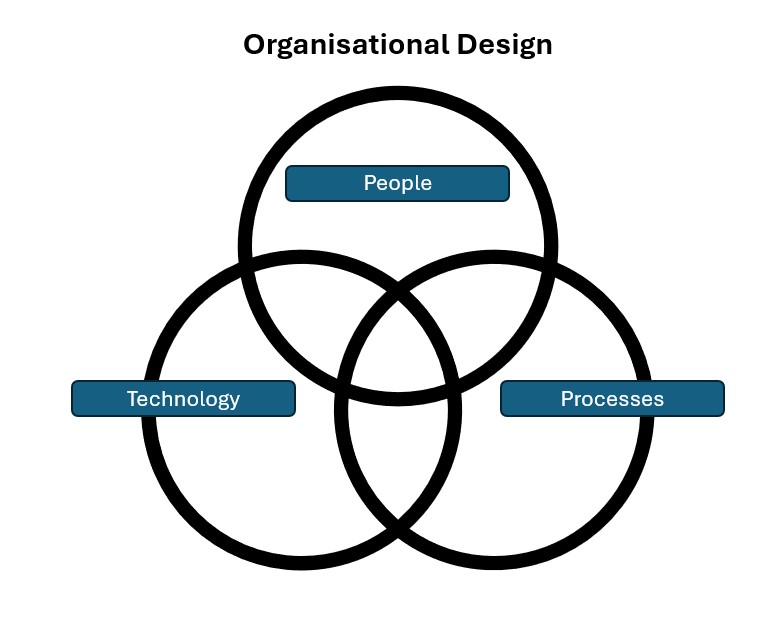
Organisational Design is a topic and agenda at top of mind for a lot of businesses, on an on-going continual basis. In this post, I look at a few ‘real-world’ implementations of unique models where organisations are attempting to stay ahead of competitors in how they operate.
Innovative Organisational Design: Shaping the Future of Work
In today’s rapidly evolving business landscape, innovative organisational design has become crucial for companies aiming to stay competitive and adaptable. By rethinking traditional structures, companies can foster greater agility, collaboration, and responsiveness to market demands. Forward-thinking organisations are experimenting with flatter hierarchies, autonomous teams, and even hybrid work models that prioritise flexibility and employee empowerment. Here, we’ll explore some real-world examples of companies that have successfully implemented innovative organisational designs to drive success.
1. Spotify’s Squads, Tribes, and Guilds Model
One of the most celebrated examples of innovative organisational design comes from Spotify. The streaming giant introduced a model that breaks away from traditional hierarchies, organising employees into “squads,” “tribes,” and “guilds.” Each squad is a small, cross-functional team responsible for a specific aspect of Spotify’s product, empowered to operate with high autonomy. Tribes are groups of squads that work on related projects, enabling knowledge sharing and alignment across teams. Meanwhile, guilds are informal communities that connect employees across tribes based on shared expertise, such as software engineering or product design.
Spotify’s model promotes collaboration and rapid iteration, key elements for a tech company that needs to respond quickly to changes in the digital landscape. By giving teams ownership over their work and reducing bureaucratic bottlenecks, Spotify can maintain a startup-like agility even as it scales. Other organisations, especially in tech, have adopted variations of this model, recognising its effectiveness in balancing autonomy with alignment.
2. Haier’s Micro-Enterprise Model
Chinese appliance manufacturer Haier restructured its organisation into a “micro-enterprise” model, transforming its traditional hierarchy into a network of small, autonomous teams. Each micro-enterprise operates like a mini-startup within Haier, with its own profit-and-loss responsibilities. Employees are incentivised through a “platform ecosystem,” where successful teams can grow and even spin off as independent businesses. This structure fosters a culture of entrepreneurship, where team members are highly motivated to innovate and take ownership of their results.
Haier’s approach has led to rapid growth and enhanced customer responsiveness. The micro-enterprise model allows the company to tap into its employees’ entrepreneurial spirit and adapt quickly to market demands. Haier’s success demonstrates that large organisations don’t have to sacrifice agility for scale; instead, they can break down rigid structures to enable flexibility and responsiveness.
3. Zappos’ Holacracy Model
Zappos, the online shoe retailer, is known for its commitment to customer service and employee satisfaction. In 2014, Zappos adopted “holacracy,” a management approach that eliminates traditional job titles and hierarchies. Instead, employees take on multiple roles within self-organising teams. Decision-making is decentralised, allowing employees at all levels to contribute ideas and assume responsibility for their work.
While the transition to holacracy was challenging, Zappos found that this model created a dynamic work environment where employees felt more engaged and empowered. Although not every aspect of holacracy was successful, it enabled Zappos to experiment with new ways of working and reinforce a culture of innovation and collaboration.
4. Strapart Group: Embracing Hybrid and Remote Work Flexibility
The Strapart Group, a forward-thinking global organisation, has embraced a hybrid work model, allowing employees to choose between in-office and remote work. This design was tailored to improve work-life balance and enhance productivity, recognising that flexibility is increasingly vital for attracting and retaining top talent. By focusing on outcomes rather than rigid schedules, Strapart has fostered a more flexible and responsive workforce.
This model demonstrates how organisations can adapt their structures to meet modern workforce expectations, especially in a post-pandemic era where flexibility is a competitive advantage. Strapart Group’s success highlights the importance of aligning organisational design with employee needs to drive long-term growth.
To summarise; innovative organisational design is reshaping how businesses operate, fostering resilience, agility, and adaptability. From Spotify’s squads and tribes to Haier’s micro-enterprises, these real-world examples demonstrate that companies willing to experiment with new structures can achieve remarkable results. As the future of work continues to evolve, organisations must keep rethinking their design, empowering employees, and embracing models that align with the ever-changing business environment.


 TCW Consulting - Independent HR Support Services
Leave a comment