
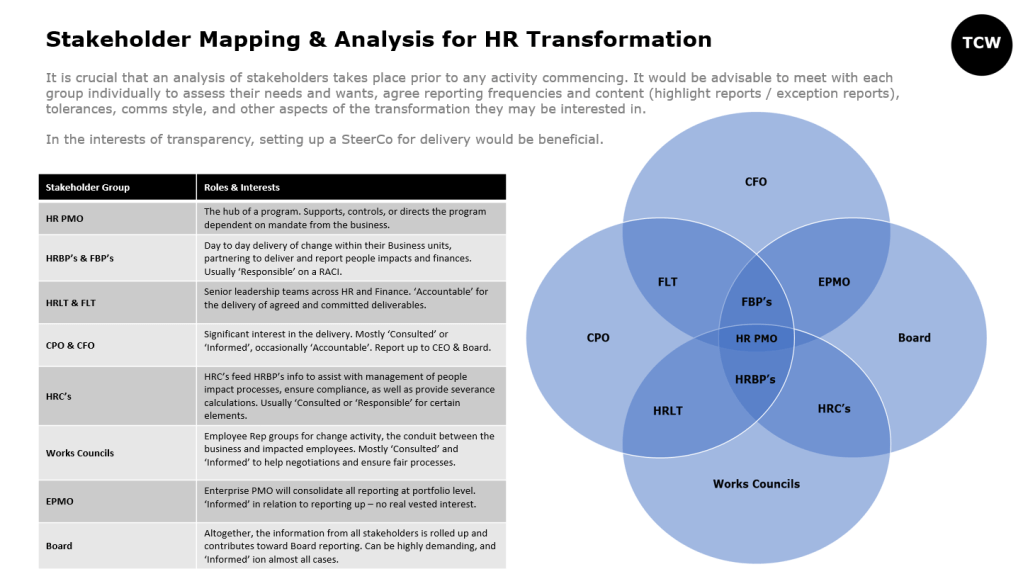
Stakeholders have the ability to make or break a program or project. Having them on-side early in the planning stages is critical to successful delivery. Below are a few tips to consider when identifying and mapping your stakeholders.
Identify and Understand Your Stakeholders’ Needs
Leading up to the execution and delivery of a change and transformation program, it is important to have a clear view of the main Stakeholder(s) with a vested interested in the success or failure of the initiative(s).
When identifying your stakeholders, it is important to understand their role, and what their interest in the program is. Then, outline how you will suffice that need.
Knowing and understanding what they want, when they want it, the frequency, and format, is key. This will set the foundation on which to build a strong relationship.
Power Grid and RACI

Building a ‘Power Grid’ or RACI is a good way to visualise and map your Stakeholders.
As can be seen in the diagram above, there are 4 segments from low power / low interest, to high power / high interest. Through categorising your stakeholders in this manner, you will be able to focus your efforts in the right areas. For example, as a Program Manager delivering a program with high Board level visibility, you would be right to put them in the top right quadrant. However, it is unlikely you would have a direct link to the Board and any communications would be delivered through the traditional reporting lines.
Understanding where your Stakeholders sit within the grid, coupled with a RACI document, will enable effective prioritisation of Stakeholder engagement and management.
Communicate, Communicate, Communicate
Communication is one of, if not the most, critical factor in delivery. As part of the mapping process, it’s crucial to understand what your Stakeholders want and need from you in the reporting.
Aside from establishing any cyclical reporting processes and the contents to be shared, another move would be to set up committee calls involving all relevant stakeholders. Or, setting up multiple calls with different groups that hold similar interests. For example, you could have a call with those delivering, and then calls with those who need to be consulted and informed. However, it would make sense and for the purposes of time keeping, to have one call including all stakeholders on a call.
The level of communication should be considered, however there is only ever really an upside to more communication. More is better than less, and let your stakeholders dictate what they are comfortable with. Whereas the risks of a lack of communication can be significant, even detrimental to the point where programs are closed down. Lack of communication can also lead to a question mark over your credibility to manage, the confidence stakeholders have in your ability, and whether initiatives should receive investment if the person leading has no buy-in from those allocating the funding.
Establishing clear and concise communication processes will set the precedence and manage stakeholder expectations.


 TCW Consulting - Independent HR Support Services
Leave a comment