

In the World of work and business today, organization’s are continually evolving and adapting to a multitude of variable factors that impact on their business and operating model, their service/product-lines, and overall competitiveness.
These adaptations could be forced upon an organization as a result of regulatory or legislative change, significant economic events, geopolitical issues, and more.
With a changing business landscape such as the above, there comes a knock on effect, impacting the individuals across the organisation, including the exiting of positions no longer required as a result of moving to a new operating model. In the UK, there are strict rules that companies must comply with and adhere to when dealing with RIF’s (reduction in force).
Notification To The Business
Redesigning an organisation is more complex than it would appear, and it is advisable to have a well structured communication plan, and program plan, in place to deliver and execute the required change.
Assuming the business has already agreed on the required changes and prep work including submission of the relevant docs (HR-1 to the RPS), a notification to the business will be required, outlining the proposed change(s), the rationale for the change, potential impacts (role changes, redundancies, relocations etc.), proposed ‘high-level’ timeline of events, concluding with support on offer and a direction to internal documents if available.
There is no hard and fast rule for level of detail, and the initial notification can be as detailed as deemed necessary, as long as it covers the required points.
Program & Project Planning
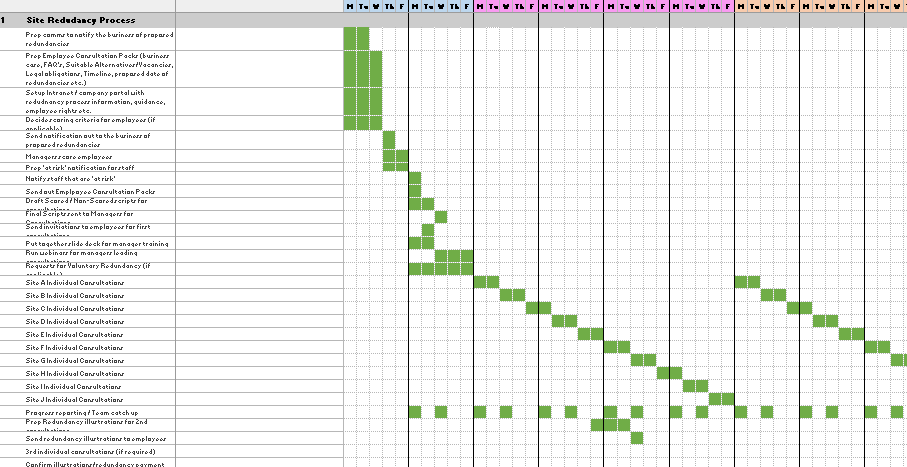
Depending on the scale of the program, will will determine the level of planning required. The program should be divided into works packages / deliverables, and then further into tasks, again depending on the size. A GANTT is helpful for visualization purposes of timelines and milestones, however a simple spreadsheet can also suffice.
The plan should include the work, task owner, start date, duration. Again, this can be as high-level or detailed as needed. Usually, the plan will run from planning/initiation stages, through to delivery and execution, and closure.
- Planning and initiation Phase – this would include setting up schedules, templates, documentation, scripts, FAQ’s, arranging outplacement providers etc. etc.
- Delivery & Execution Phase – this would be the actual delivery and facilitation of consultations, consulting employee reps, ER case work as a result of the change, query management, tracking headcount activity and statuses, arranging redeployments, calculating payments, holding workshops for managers, and so on.
- Closure – this would be when exits have been confirmed, settlements signed (if applicable), exit dates agreed, outplacement support engaged, trial periods for suitable alternatives/redeployed individuals have concluded, and all appeals have been completed.
I will write a separate post on the individual tasks to consider within a restructuring program, as again, this can vary depending on the size and scale of the number of reductions as a result of organizational change.
Feel free to drop me an email at tom@tcwconsulting.uk should you wish to discuss or want any advice. I am always open to discussions on business transformation.


 TCW Consulting - Independent HR Support Services
Leave a comment